





BUILDING TALES
Dear Reader,
We invite you on a walking tour where the buildings of Siófok will tell you their stories. In this publication, you’ll find a small taste of what awaits.
CODE-BREAKER GAME!!!
For our playful visitors, we’ve added a puzzle to make your exploration even more adventurous. Simply answer the questions related to the landmarks, and you will crack the code. Each answer is a single-digit number. Arrange the answers from the eight questions in descending order to reveal the solution.
Bring the code to the Tourinform office to claim your gift!
- Water Tower - Fő tér 11
The iconic water tower of Siófok, considered a symbol of the city, was built in 1912 based on the designs of engineers Jenő Gergely and Árpád Guth. It stands 41.3 meters tall (which is "π" backwards! 😊). It was decommissioned in 1973, and underwent a complete renovation between 2010 and 2012. Today, the ground floor houses the Tourinform office, and a lookout and exhibition space have been created in the former water tank area. From the top, you can see all the way to Badacsony.
How many entrance doors are there on the lower glass level of the water tower?
- Roman Catholic Church - Fő u. 57
Did you know that this church houses the largest organ in the Balaton region? The church, built in Neo-Romanesque style based on the designs of Károly Csomay, was consecrated on July 3, 1904, in honor of the Visitation of the Blessed Virgin Mary. Above the main entrance, you can see a painting by Endre Muzsinszki Nagy, while the triumphal arch features frescoes by György Leszkovszky, the nave showcases Béla Büky's Stations of the Cross paintings, and sculptures by Lajos Krasznay. The stained-glass windows on the facade were created in the workshop of Miksa Róth in Budapest, whose works also adorn the Parliament, the Hungarian National Bank, and the Academy of Music.
Look at the marble plaque on the church facade. What is the smallest digit you can find on it?
- Railway Station - Millennium Park 1
The Southern Railway line between Buda and Nagykanizsa was inaugurated in 1861, and Siófok received its railway stop two years later. The current station building was completed in 1903, and it was renovated in 1989-90, regaining its turn-of-the-century appearance.
How many wall-mounted lanterns can you find on the facade of the railway station facing Millennium Park?
- Synagogue - Széchenyi u. 4
This is the only synagogue in Hungary that was built during the decades of socialism. The original synagogue was constructed in 1896, but it was demolished in the 1980s. The current building was completed in 1986, based on the designs of Sándor Kovács.
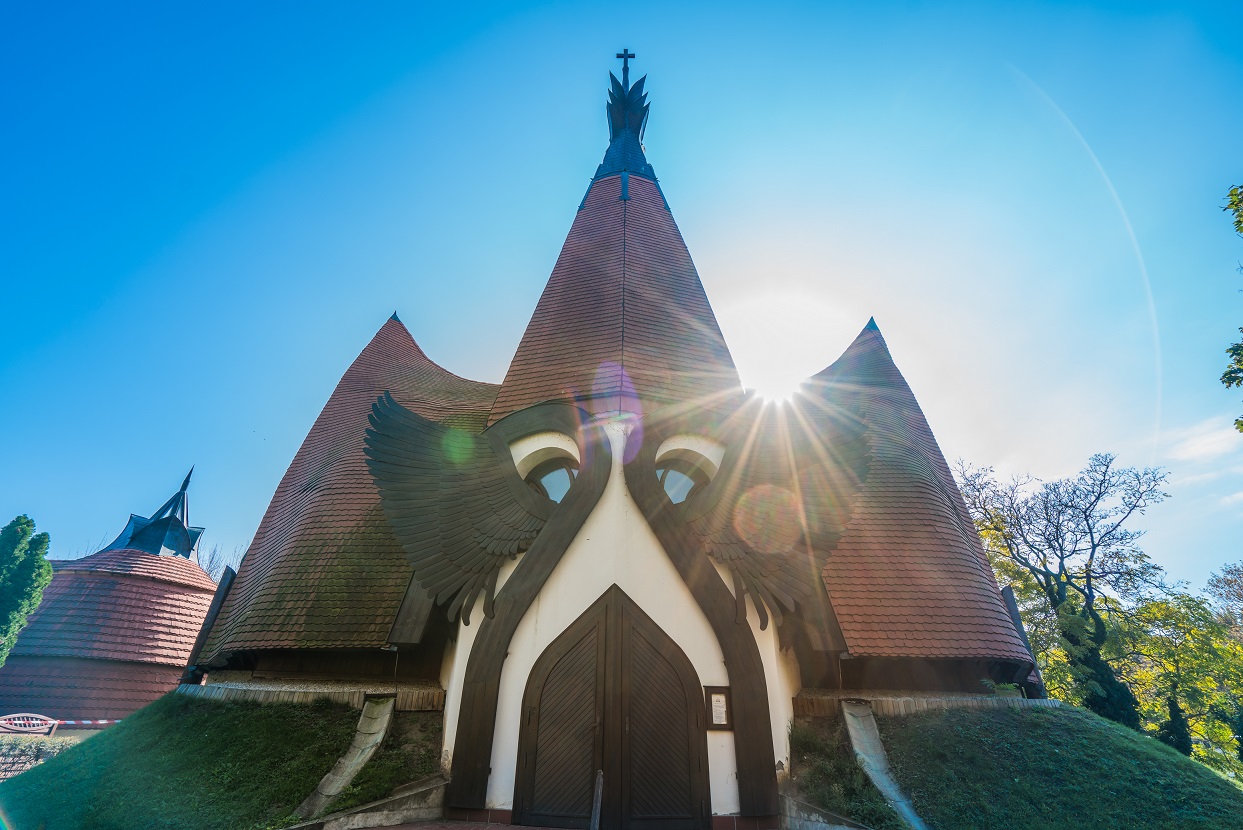
- Lutheran Church - Fő u. 220
One of the beautiful examples of Hungarian organic architecture.
The plans for the church and the parish were designed by Imre Makovecz. Its construction was supported by the congregation of Oulu, our Finnish sister city, as the timber was sourced from Finland. The church was consecrated on June 30, 1990. The sculpture of the Resurrected Christ above the altar is the work of László Péterfy, and the church interior was designed by interior architect Gábor Mezei.
How many sections does the large glass surface above the southern entrance consist of?
- Reformed Church - Kele u. 10
The new church was consecrated on September 3, 1994, on the site of the small prayer house of the Reformed community. The building was designed by architects János Ripszám and György Pápay.
- Kálmán Imre Cultural Center - Fő tér 2
The facade of the building, completed in 1976 based on the designs of the MÁV Design Institute, is covered with pyrogranite cladding from the Zsolnay factory in Pécs. The playful, geometric shapes were created by ceramic artist Anikó Kálmán.
The Center features a 465-seat air-conditioned theater with a revolving stage, a dance hall, community rooms, and exhibition space. It offers a diverse range of programs throughout the year for those interested in culture.
- City Hall - Fő tér 1
At the corner of today’s Main Square and Main Street, a finely crafted, towered municipal building befitting the status of the spa town was constructed in the early 1900s. Unfortunately, it was demolished in the late 1950s. The current building on the southern side of Main Square was inaugurated in 1972.
How many flagpoles can be counted on the facade facing Main Square?
- Imre Kálmán Memorial House - Kálmán Imre sétány 5
The world-famous operetta composer Imre Kálmán was born here on October 24, 1882, and lived in this building with his family until he was 9 years old. From 1970, the music school operated here, and after it moved out, the Imre Kálmán Museum (now called the Memorial House) opened on October 22, 1987. Some of Imre Kálmán's most famous operettas are: The Gypsy Princess, The Bayadere, Countess Maritza, The Circus Princess, The Chicago Princess, and The Devil’s Rider. The treasured belongings of the birthplace are well protected.
How many keyholes can you find on the entrance door?
- Jókai Villa - Batthyány u. 2
The villa was commissioned by Dávid Braun and constructed in 1897. In 1903, as a guest of the owner, the famous hungarian writer, Mór Jókai spent his last summer in this building. The villa is currently privately owned and operates as a hotel.
- Krúdy Villa - Mártírok u. 4
The building was commissioned by Ede Ellinger, a photographic artist, and constructed between 1893 and 1896. This villa was rented by Gyula Várady, and famous hungarian writer Gyula Krúdy spent several summers here as his guest. The building was renovated and expanded in 1990, and it now operates as a guesthouse.
- Sió and Hullám Hotels - Petőfi sétány 1
The buildings, known as the Sió and Hullám Hotels, were the first hotels in Siófok, opening their doors in 1893 with 45 rooms. After World War II, they operated as a resort. The buildings underwent significant renovation in 2001 and are now owned by the local government, serving educational purposes.
- Thanhoffer Villa - Petőfi sétány 4
The villa was commissioned by Lajos Thanhoffer (1843-1909), a professor of medicine, and was constructed in 1897. It was nationalized in 1953 and operated as a resort. The city of Siófok purchased it in 1996, and it now operates as a guesthouse.
The fence surrounding the villa property has stone globes atop the stone pillars along the streets. How many stone globes are there in total?
- Lock / Sluice - Krúdy sétány 2
The creation of the Sió Canal began during the reign of Emperor Galerius in ancient Rome. The first wooden lock was built in 1863, after the construction of the railway, and was replaced in 1891 by a concrete lock with metal plates. After several renovations, the complete reconstruction began in 2020. The new lock, which also serves as the city's newest public space, was opened in 2024.
A model of Lake Balaton can be found at the lock area. How many lock wheels are visible on it?
- Meteorological Observatory - Vitorlás u. 17
Designed by Péter Molnár, this observatory was built in 1956. It is the source of the first storm warning for the entire Balaton region.
